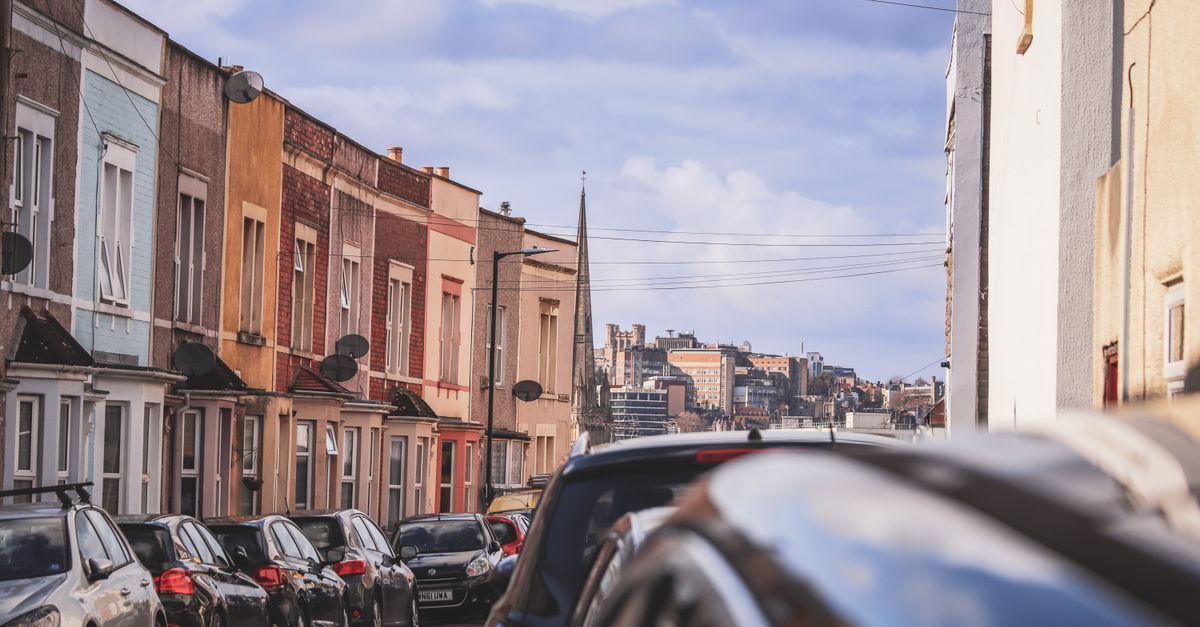
Kingsdown sits on the steep hill directly above the city centre, wedged between Cabot Circus and Cotham, and it's easy to miss because almost nobody drives through it on purpose. You get to it by climbing St Michael's Hill on foot, past centuries stacking up in reverse: modern university buildings at the bottom, Georgian terraces higher up, and a scatter of far older almshouses near the top. It's one of Bristol's most walkable central neighbourhoods, and one of the least visited by anyone who isn't already living or studying there.
What the area is actually like
Kingsdown is mostly residential, a dense grid of Georgian and Victorian terraces built in the early 1700s and 1800s by Bristol merchants who wanted to be close to the docks and the centre without living in the noise of it. Many of those houses survive as Grade II listed terraces, with sash windows, wrought-iron railings and the kind of proportions that look right from every angle. Because it sits right next to the University of Bristol campus and the Bristol Royal Infirmary, the population is a mix of long-term residents, hospital staff and a large student contingent in HMO houses and purpose-built blocks.
The centrepiece is Kingsdown Parade, a row of shops, a pub or two and independent cafes running along the ridge, plus the green square of Kingsdown itself, a genuinely quiet patch of grass and trees that most visitors to Bristol never see. At the top of St Michael's Hill, the high street has a supermarket, a handful of pubs and a run of independent cafes serving the university and hospital crowd, busy with a completely different rhythm to the tourist streets down the hill.
Getting there
Kingsdown is a genuine walk-up neighbourhood. From the city centre or Cabot Circus, it's a steep but short climb up St Michael's Hill, roughly ten to fifteen minutes on foot. From Clifton or Redland, it's a similarly short walk or a couple of stops on the buses that run along Whiteladies Road and up towards the hospitals. Because it sits on a hill with narrow Georgian streets, driving in isn't the easiest option, and most of it falls inside a residents' parking zone, so if you're bringing a car, check our residents' parking zones guide before you park on-street.
Why you'd visit
There's no single ticketed attraction here, and that's rather the point. Kingsdown rewards a slow walk: the run of Georgian terraces on St Michael's Hill and Somerset Street, the almshouses tucked into the hillside, and the green square itself as a spot to sit that isn't full of tourists. It also works as a quieter, cheaper base if you're visiting Bristol and want to be within walking distance of the centre, Cabot Circus and Gloucester Road without paying Clifton prices. For a wider view of how it fits against Bristol's better-known areas, see our neighbourhoods guide, and if you're considering the city as somewhere to live rather than visit, our guide to moving to Bristol covers where Kingsdown sits on rent and character compared with Clifton, Redland and Bishopston.
Kingsdown compared with its neighbours
| Kingsdown | Clifton | Cotham | |
|---|---|---|---|
| Feel | Georgian hillside, studenty | Grand Georgian, tourist draw | Residential, family-leaning |
| Walk to centre | 10-15 min | 20-25 min | 15-20 min |
| Best for | Quiet base, hospital/university visits | Suspension Bridge, boutique shopping | Chandos Road cafes, family stays |
| Parking | Residents' zone, tight streets | Residents' zone, busy at weekends | Residents' zone |
The honest take
Kingsdown isn't a destination in the way Clifton or the Harbourside are, and if you've only got a day or two in Bristol, it's not where you should spend your limited time. But if you're staying nearby for the university or the hospital, or you just want a genuinely local, quiet corner of central Bristol to walk through on your way somewhere else, it's worth the climb. Pair it with a walk down through Stokes Croft or across to Gloucester Road, both a short walk away, for a fuller picture of how this side of the city fits together.